



- July 22, 2026
- admin_wec
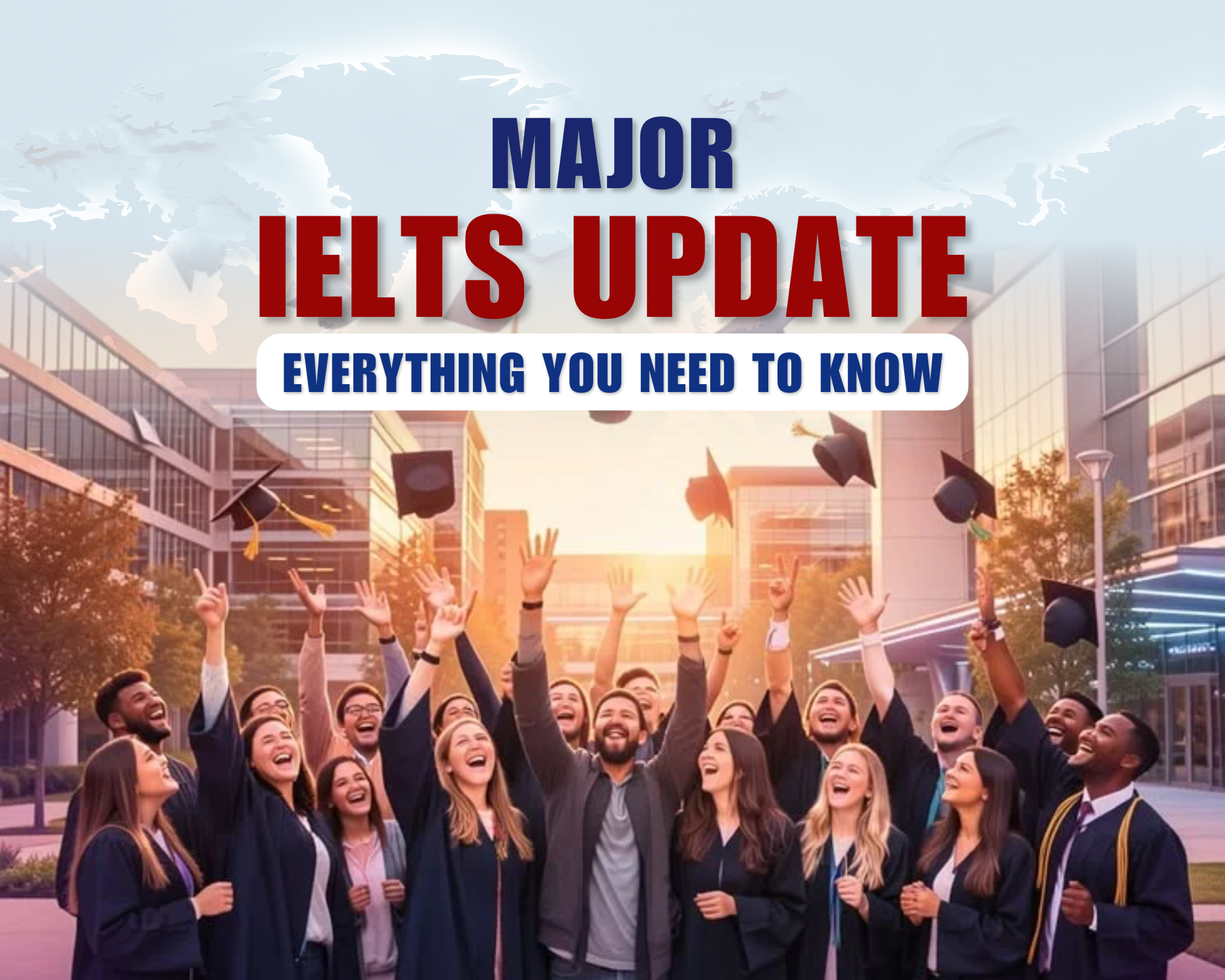
Major IELTS Update for Test Takers: Everything Changing in 2026
If you've booked IELTS or are planning to sit for it soon, there's a major update you cannot afford to miss. The test is undergoing its biggest transformation in years, and for students across Surat and Gujarat aiming for the UK, Australia, Canada, or emerging destinations like Germany and Ireland, staying ahead of these changes could be the difference between a Band 6.5 and the Band 7+ your dream university demands.
Every year, thousands of aspirants from Gujarat sit for IELTS with outdated strategies, relying on prep material and shortcuts that worked for previous test cycles. This year, that approach is riskier than ever. The changes rolling out through 2026 aren't just administrative tweaks they touch how the test is delivered, how it's scored, and what kind of preparation actually pays off. Here's everything you need to know, broken down clearly.
Major IELTS Update: What's Actually Changing
The IELTS partners - British Council, IDP IELTS, and Cambridge University Press & Assessment have confirmed that paper-based IELTS is being phased out from mid-2026. Every test-taker will move to computer-delivered IELTS, with the rollout timeline varying by test centre and city. This isn't a cosmetic switch. Candidates choosing the computer-delivered format have consistently reported faster results, more flexible test-day scheduling, and access to a feature that's reshaping how students plan their prep: One Skill Retake.
One Skill Retake means that if you fall short in just one section say, Writing - you no longer need to retake the entire exam. You can retake that single weak section and combine it with your stronger scores from the original attempt. For students juggling application deadlines, this alone can save weeks of lost time, and it also changes exam strategy. Instead of spreading your energy evenly across all four sections in the final days before your test, you can now afford to identify your weakest area and give it focused, disproportionate attention, knowing you have a safety net if that section underperforms.
There's also good news for students who genuinely prefer pen over keyboard: a "Writing on Paper" option is being introduced in select markets, letting you handwrite your Writing responses even while completing the rest of the test on computer. This is a thoughtful concession for candidates who find typing under exam pressure more stressful than helpful. And to be clear none of this changes what the test measures or how your score is read by universities and visa officers. A Band 7 is still a Band 7, whether it was earned on paper, on screen, or through a One Skill Retake.
IELTS Update 2026: The Quiet Shift Toward Authenticity Over Memorisation
Beyond the digital shift, the more important change is happening inside the test itself. Across Listening, Reading, Writing, and Speaking, IELTS is steadily moving away from predictable, memorisable patterns and this is the part most students are still underestimating.
In Speaking, examiners are getting sharper at spotting rehearsed, template-based answers. Genuine, in-the-moment responses to follow-up questions are being rewarded, while scripted monologues are being penalised. This means the old strategy of memorising a bank of Part 2 cue card answers and adapting them on the fly is becoming far less reliable. Examiners are specifically trained to probe deeper with unexpected follow-ups designed to break rehearsed answers apart.
In Writing, generic essay templates are losing their edge. Task 2 prompts are more specific and open-ended, designed to reward original arguments over recycled structures. Essays that plug real examples, personal reasoning, and locally relevant context into a formulaic five-paragraph shell are increasingly easy for examiners to spot and score accordingly. Genuine critical thinking, not a memorised introduction phrase, is what separates a Band 6 from a Band 7.5 now.
In Listening, a wider range of accents and more realistic background audio are challenging students who trained only on predictable exam patterns. Where older prep material leaned heavily on clear, slow, neutral-accented audio, current test cycles are introducing more natural speech patterns, overlapping dialogue, and regional variation closer to what students will actually encounter in lecture halls and daily life abroad.
In Reading, denser, more analytical passages are testing genuine comprehension rather than keyword-spotting shortcuts. Passages increasingly draw from opinion pieces, data commentary, and layered arguments that can't be solved by simply matching words in the question to words in the text. Students need to actually understand the writer's stance and reasoning to answer confidently.
In short: the test-takers who benefit most from this update are the ones who can actually communicate - not the ones who memorised the most templates.
Why This Matters More Than Ever for Study Abroad Plans
This update isn't happening in isolation. Visa policies across the UK, Australia, and Canada are tightening in parallel, with stricter financial checks and "genuine student" verification becoming the norm. Universities and immigration authorities are placing more weight on English proficiency scores as a genuine indicator of readiness not just a box to tick. Some destinations have also raised their minimum score thresholds for both admissions and visa processing, meaning a "safe" score from a couple of years ago may no longer clear the bar. That makes this the wrong year to prepare the old way, and the right year to build real, transferable English skills that will also serve you once you're actually studying abroad.
How WEC Overseas Education Is Helping Students Adapt
At WEC Overseas Education in Surat, we've already rebuilt our IELTS coaching around this update. Our computer labs replicate the exact digital test environment so there are no surprises on test day. Our trainers run dedicated One Skill Retake mock sessions to help students strategically target their weakest section instead of spreading effort too thin. And critically, our Speaking practice is built entirely around spontaneous, unscripted conversation not scripts to memorise because that's what the updated test actually rewards.
With 15+ years of experience and over 500 Gujarat students hitting their target bands last year, our approach is built on one principle: prepare for the IELTS you'll actually sit, not the one from a few years ago. From personalised diagnostic assessments to focused writing workshops and mock speaking panels, every part of our program has been re-calibrated to match where the test is heading, not where it used to be.
How to Prepare, Starting Today
- Check your test centre's transition timeline to know when computer-delivered testing becomes mandatory in your city.
- Switch your mock practice to on-screen formats immediately, especially for Writing.
- Retire your memorised speaking answers and start practising genuine, unscripted responses instead.
- Reconfirm your target university's and visa country's current English score requirements - these are shifting too.
- Book a free diagnostic mock with WEC to see exactly where your score stands today.
Final Thoughts on the Major IELTS Update
This major IELTS update rewards exactly what should matter most: real communication ability. Students who adapt their preparation now, rather than after a disappointing result, will be the ones walking into their test centre with confidence and walking out with the score their dream university is asking for.
Ready to prepare the right way? Book your free diagnostic mock with WEC Overseas Education today.
Follow us for real-time updates & immigration news: Instagram | Facebook
- 17 October 2026
- admin_wec
- 10 October 2026
- admin_wec

- 03 October 2026
- admin_wec

- 26 September 2026
- admin_wec
- 19 September 2026
- admin_wec