



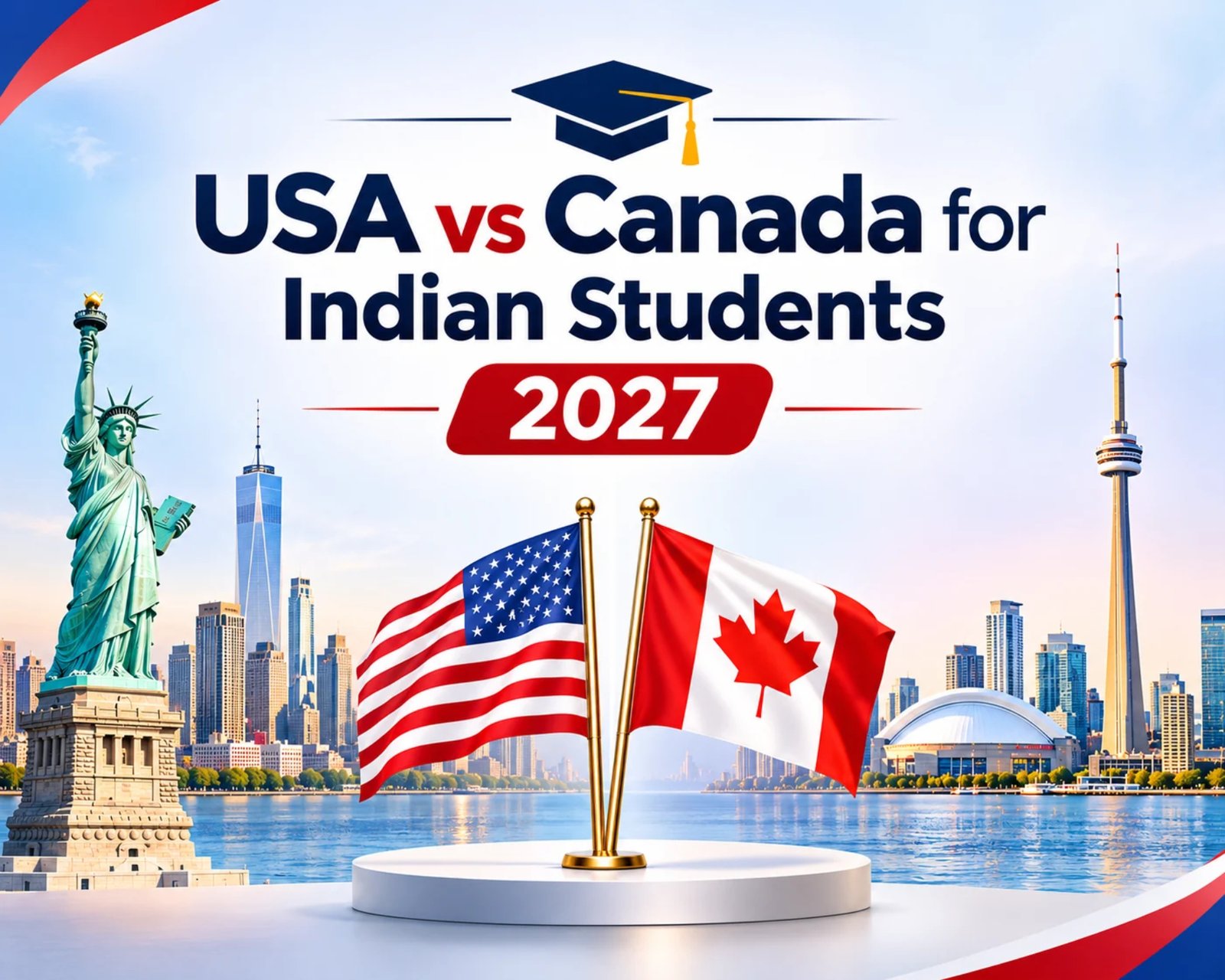
USA vs Canada for Indian Students 2027: 7 Best & Powerful Differences
- November 21, 2026
- admin_wec
USA vs Canada for Indian Students 2027: 7 Essential Benefits & Differences
Are you planning to study abroad in 2027 but confused between the USA and Canada? Both countries are popular destinations for Indian students because of their internationally recognised universities, career opportunities and wide range of courses. However, choosing the right destination requires careful planning.The USA vs Canada for Indian students 2027 comparison involves several important factors, including tuition fees, student visa requirements, part-time work opportunities, post-study work permits and future career prospects.Both countries have different education systems and immigration policies. Therefore, students should understand the latest requirements before selecting a university or paying an admission deposit.In this guide, we compare the USA and Canada across seven important factors to help you choose a destination that matches your academic background, financial situation and career goals.USA vs Canada for Indian Students 2027: Quick Comparison
Before exploring the details, here is a quick comparison of the two study destinations.| Factors | USA | Canada |
|---|---|---|
| Student visa | F-1 Student Visa | Canadian Study Permit |
| Admission document | Form I-20 | Letter of Acceptance |
| Popular courses | STEM, IT, Business, Engineering | IT, Healthcare, Engineering, Business |
| Part-time work | Generally up to 20 hours weekly on campus during academic sessions | Up to 24 hours weekly off campus for eligible students |
| Post-study work | OPT and STEM OPT extension | PGWP for eligible graduates |
| University options | Public and private universities | Public and private institutions |
| Education costs | Vary by university and location | Vary by university and province |
1. USA vs Canada Student Visa Process
The student visa process is one of the first things Indian students should understand when comparing the USA and Canada.Although both countries welcome international students, their application procedures and documentation requirements are different.USA Student Visa Requirements
Indian students planning to study in the USA generally need an F-1 student visa.The application process usually includes:- Apply to a university authorised to enrol international students.
- Receive Form I-20 from the institution.
- Pay the SEVIS fee.
- Complete the DS-160 visa application form.
- Schedule and attend the visa interview.
- Demonstrate sufficient financial support for your education and living expenses.
Canada Student Visa Requirements
Indian students planning to study in Canada generally need a Canadian study permit.The application process usually involves:- Receive an offer letter from a Designated Learning Institution (DLI).
- Obtain a Provincial Attestation Letter (PAL) or Territorial Attestation Letter (TAL), if required.
- Arrange the required financial documents.
- Complete the online study permit application.
- Submit biometrics and any additional documents requested.
- Wait for the application decision.
2. Cost of Studying in the USA vs Canada
The cost of education is one of the biggest considerations for Indian students planning to study abroad.However, neither country has one fixed tuition fee. The total cost depends on the university, programme, city and duration of study.Cost of Studying in the USA
The USA offers both public and private universities. Some private universities have high tuition fees, while certain public universities offer comparatively affordable programmes.Students should consider these expenses:- University tuition fees
- Accommodation and rent
- Food and daily expenses
- Health insurance
- Transportation
- University and administrative charges
Cost of Studying in Canada
Canada offers different tuition options depending on the institution and programme. However, students must also meet the financial requirements for their study permit.For study permit applications submitted on or after September 1, 2026, a single applicant outside Quebec must demonstrate at least CAD 23,448 for annual living expenses. This amount excludes tuition fees and transportation.Students should prepare a realistic budget covering tuition, accommodation, food, insurance and personal expenses.For the latest requirements, visit the official IRCC Proof of Financial Support page.Which Country Is More Affordable?
When comparing USA vs Canada for Indian students 2027, it is important to calculate the complete cost rather than comparing tuition fees alone.Canada may be more affordable for some students, but this is not always the case. A public university in the USA may cost less than a particular Canadian institution.Compare the following before making a decision:- Total tuition fees
- Accommodation expenses
- Living costs
- Health insurance
- Available scholarships
- Course duration
3. Part-Time Work Opportunities for International Students
Many Indian students look for part-time employment to gain work experience and manage some of their living expenses.Both countries allow eligible international students to work under specific conditions. However, the permitted working arrangements are different.Part-Time Work in the USA
F-1 international students are generally permitted to work on campus for up to 20 hours per week while classes are in session.Off-campus employment is restricted and requires the appropriate authorisation.Some employment options include:- On-campus employment
- Curricular Practical Training (CPT)
- Optional Practical Training (OPT), where eligible
Part-Time Work in Canada
Eligible international students in Canada can generally work off campus for up to 24 hours per week during regular academic sessions.They may also work unlimited hours during scheduled academic breaks if they meet the eligibility conditions.However, students must follow the conditions of their study permits and maintain their eligibility.Working more than the permitted hours can lead to serious immigration consequences.Read the official IRCC Off-Campus Work Rules.Important: Students should not depend on part-time employment to pay their complete tuition fees or essential living expenses. They should arrange sufficient funds before travelling.4. Post-Study Work Opportunities: OPT vs PGWP
Post-study work opportunities are among the most important factors in the USA vs Canada for Indian students 2027 comparison.Both countries offer options for eligible international graduates to gain work experience after completing their education. However, the conditions are different.Post-Study Work in the USA
The USA offers Optional Practical Training (OPT) to eligible F-1 students.OPT allows students to gain practical experience in a job related to their field of study.Important points include:- Eligible students may receive up to 12 months of OPT.
- Eligible graduates in qualifying STEM fields may apply for a 24-month STEM OPT extension.
- Students must meet the relevant application and employment requirements.
- OPT does not automatically lead to permanent residency.
Post-Study Work in Canada
Canada offers a Post-Graduation Work Permit (PGWP) to eligible international graduates.The permit allows qualifying graduates to gain work experience in Canada after completing their studies.However, not every institution or programme qualifies.Important eligibility considerations include:- The institution must meet the relevant DLI requirements.
- The programme must meet applicable PGWP eligibility conditions.
- Language proficiency requirements apply.
- Field-of-study requirements may apply to certain programmes.
5. Best Courses to Study in the USA and Canada
Both countries offer excellent academic opportunities. The right destination depends on your previous education, interests and future career plans.Popular Courses in the USA
The USA is a strong option for students interested in:- Computer Science
- Artificial Intelligence
- Data Science
- Engineering
- Business Administration
- Finance
- Biotechnology
- Research-based programmes
Popular Courses in Canada
Canada offers programmes in several academic and professional areas, including:- Healthcare and Nursing
- Information Technology
- Engineering
- Business Management
- Data Analytics
- Construction and Skilled Trades
6. University Intakes and Application Timeline for 2027
Planning your application early can help you identify suitable universities, prepare documents and complete the visa process on time.Both countries offer multiple intakes, but availability varies by institution and programme.USA University Intakes
The main university intakes in the USA include:Fall Intake – August/SeptemberFall is one of the major admission periods, with a wide range of universities and programmes available.Spring Intake – JanuarySpring is another popular option for students who do not want to wait for the next Fall intake.Summer Intake – May/JuneSome universities offer selected programmes during the summer intake.Canada University Intakes
The main university intakes in Canada include:Fall Intake – SeptemberFall is a major admission period, with a wide selection of courses and institutions.Winter Intake – JanuaryWinter intake is suitable for students who prefer beginning their studies at the start of the year.Summer Intake – MaySome Canadian institutions offer selected courses during this period.For 2027, students should pay attention to admission deadlines, available seats, financial documents and study permit requirements.Explore our Canada January 2027 Intake Guide.7. English Language Requirements: IELTS, PTE and TOEFL
English language proficiency is an important admission requirement for many universities in both countries.Indian students may need to demonstrate their English language skills through an accepted test.Commonly accepted tests include:- IELTS Academic
- PTE Academic
- TOEFL iBT
- Which tests your university accepts.
- The required overall score.
- The minimum score in each section.
- Whether alternative English language evidence is accepted.
USA vs Canada for Indian Students 2027: Which Country Is Better?
After comparing tuition fees, visa requirements, work opportunities and courses, the next question is which country should you choose?There is no single answer for every student. Your decision should depend on your academic profile, financial situation and future career goals.| Your Preference | Country to Consider |
|---|---|
| Research-based education and specialised STEM programmes | USA |
| A wide range of university and course options | USA |
| Career-focused programmes in healthcare and skilled trades | Canada |
| Comparing different tuition and living-cost options | Both |
| Gaining work experience after graduation | Compare OPT and PGWP eligibility |
| Exploring long-term immigration options | Compare current immigration requirements in both countries |
When Should You Choose the USA?
The USA may be suitable if you:- Want to study at a research-focused university.
- Are interested in specialised STEM or business programmes.
- Want access to a wide selection of academic institutions.
- Have a budget that matches your preferred university.
When Should You Choose Canada?
Canada may be suitable if you:- Are interested in career-focused academic programmes.
- Have found a suitable DLI and PGWP-eligible programme.
- Can meet the study permit financial requirements.
- Want to explore eligible post-study work opportunities.
Plan Your Study Abroad Journey with WEC Overseas Education
Choosing between the USA and Canada is an important decision. The right guidance can help you avoid selecting an unsuitable course or university.At WEC Overseas Education, students can explore study opportunities based on their academic qualifications, budget and career goals.Our team can help you understand university options, admission requirements and the documentation needed for your application.Start by exploring: For personalised guidance, contact WEC Overseas Education and take the next step towards your international education journey.Frequently Asked Questions
1. Is the USA or Canada better for Indian students in 2027?
Both countries offer good study opportunities. The USA is worth considering for research-based and specialised programmes, while Canada offers a range of career-focused courses and eligible post-study work opportunities. Your budget, academic profile and career goals should guide your decision.2. Which country is cheaper for Indian students, the USA or Canada?
The cost depends on the university, course and city. Canada may offer lower tuition at some institutions, but this is not always the case. Students should compare tuition fees, accommodation, insurance and daily expenses before deciding.3. Can Indian students work part-time while studying in the USA and Canada?
Yes. Eligible F-1 students in the USA can generally work on campus for up to 20 hours per week during academic sessions. Eligible students in Canada can generally work off campus for up to 24 hours per week during regular academic sessions.4. Which country offers better post-study work opportunities?
The USA offers OPT and a possible STEM OPT extension for eligible graduates. Canada offers the PGWP to eligible graduates. The best option depends on the student's programme and eligibility.5. Is IELTS compulsory for studying in the USA or Canada?
Not necessarily. Many universities accept IELTS, PTE Academic or TOEFL, while some institutions may accept alternative English language evidence. Students should check the exact requirements of their chosen university.6. Can I apply to universities in both the USA and Canada?
Yes. Indian students can apply to universities in both countries if they meet the admission requirements. However, each country's application and visa process must be completed separately.7. When should I apply for the 2027 intake?
Start researching universities and preparing documents well in advance. Application deadlines differ by institution, and visa processing requires additional planning. Check the official university deadlines for your intended intake.Conclusion
The USA vs Canada for Indian students 2027 comparison shows that both destinations have different advantages. The USA offers a broad selection of universities, research opportunities and specialised programmes. Canada offers a range of academic options and post-study work opportunities for eligible graduates.There is no single best country for every student. The right destination depends on your academic background, financial capacity, preferred course and long-term career plans.Compare your options carefully, verify the latest visa requirements and choose a university that supports your future goals.Start your study abroad journey with WEC Overseas Education and make an informed decision about your future.Follow us for the latest study-abroad updates on Instagram and Facebook.USA vs Canada for Indian Students 2027: 7 Best & Powerful Differences
- 21 November 2026
- admin_wec
Canada Study Permit Processing Time 2026: 7 Essential IRCC Updates – Complete Guide
- 18 November 2026
- admin_wec

UK Earned Settlement 2026: 10 Ultimate ILR Changes You Must Know
- 03 November 2026
- admin_wec

USA Study Visa 2027: 10 Essential Requirements & Powerful Tips
- 31 October 2026
- admin_wec
PTE Exam Changes: 10 Powerful Updates for a Better Score
- 24 October 2026
- admin_wec